This article is all about the product operating model transformation and learnings from Carlotta Negri di Sanfront’s time as CPO of giffgaff, a major UK telco. Carlotta is now a fractional CPO and a career and product coach.
As CPO of giffgaff she led a fundamental organizational transformation programme, migrating the product org from fragmented silos to a measurable, product‑centric operating model.
This is a tutorial from a recent live class taught by Carlotta for Hustle Badger.
In it Carlotta set out how to go about driving a product operating model transformation programme: starting from explaining the rationale, all the way to being comfortable with failure.
Organizational transformation only works when every level of the hierarchy is onboard, and when change is iterative and test led. Below you’ll find a step-by-step roadmap towards transformation success.
Let’s get into it now.
Auditing where you are now
👉Sign up for more live classes
📽️Follow us on Youtube
Conducting an initial audit helps baseline the current situation and create clarity around where you are now.
Organizational elements to review to assess readiness for a product operating model:
- Sponsorship: Public CEO endorsement for product‑centric change.
- Shared definition: Have clear language which describes desired outcomes
- Measurable objectives: Four company objectives mapped to product outcomes (OKRs).
- Teams: Cross‑functional squads with product, engineering, UX, data and commercial representation.
- Trials: Defined experiment framework; explicit learn/no‑learn criteria and durable support for iterative cycles.
- Talent: Product managers and UX leads with P&L capability; plan for upskilling and targeted hires.
- Data: Analysts embedded in teams; product‑ready dashboards and agreed data ownership.
- Tech: Minimal viable technical debt plan; tooling and automation to speed delivery.
- Governance: Clear decision rights, meeting cadence and board reporting for product outcomes.
- Budgeting: Shared resource model; stretch targets that create incentives for product teams to deliver upside.
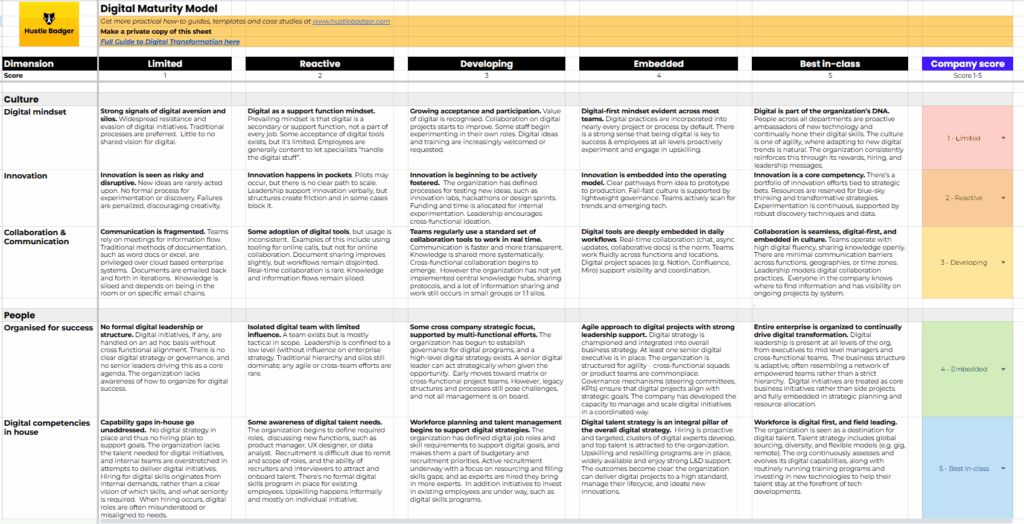
The Hustle Badger Digital Maturity Model
Be clear on the context
Start by naming the forces pushing for change.
At giffgaff the prompt was threefold:
- Market pressure: saturated telco market with shrinking margins and a need for new revenue streams (for example, broadband and roaming).
- Operational efficiency: preserve low opex while getting more output from product and tech teams.
- People and culture: a growing disconnect between product & tech and other functions such as marketing and finance.
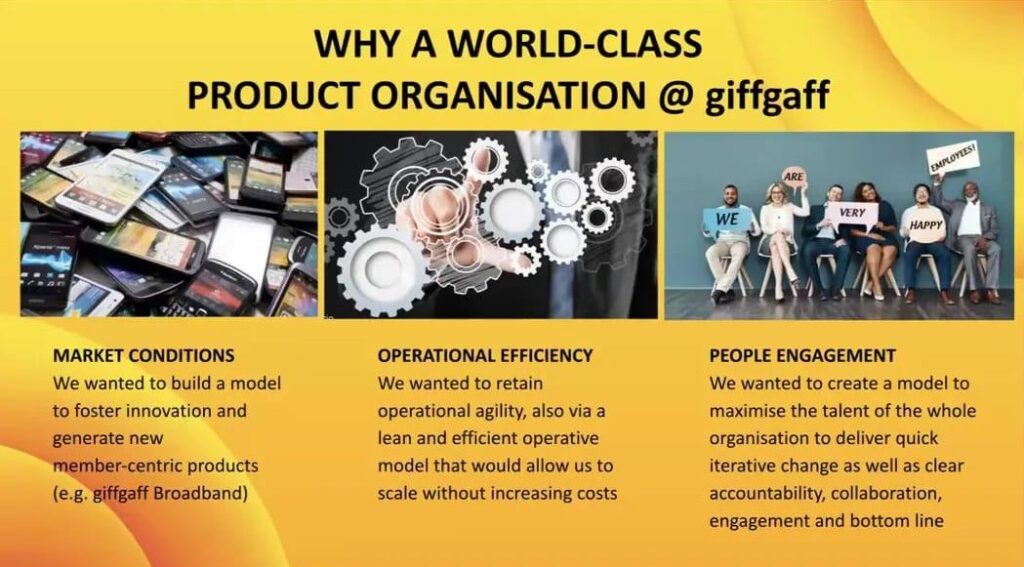
A clear articulation of the why makes it easier to align leadership and to justify the difficult trade‑offs that follow. Carlotta Negri di Sanfront emphasised that the “why” must be concrete enough that a salesperson, finance lead or engineer can see how it affects their daily work.
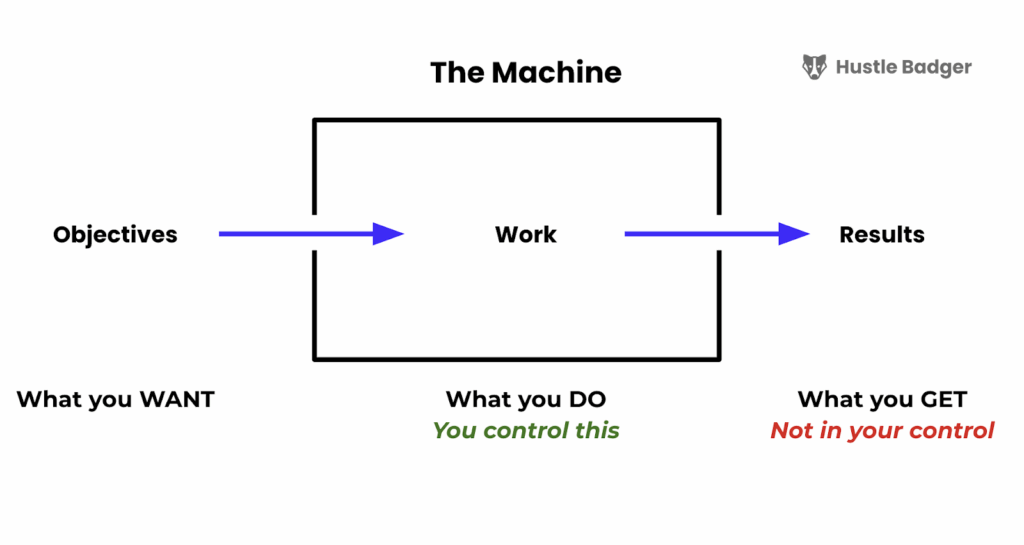
Get the Hustle Badger article on Building Your Product Operating Model
Agree a shared definition and language
Before changing how people work, agree what you mean by “product‑centric” or “product operating model”.
At giffgaff the team adopted an existing definition (Cagan’s) rather than inventing a bespoke one. That had three benefits:
- Reduces cognitive load: people can read a shared framework rather than interpret ad hoc language.
- Limits misinterpretation: vendors, investors and non‑product functions can align on the same terms.
- Metrics over jargon: Focuses the change on measurable outcomes rather than slogans.
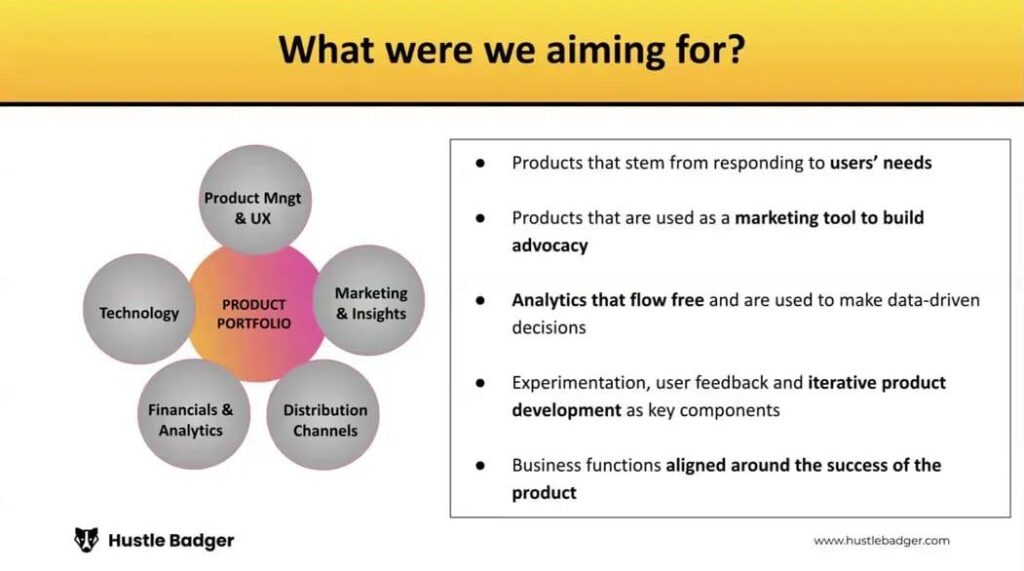
Example: ban buzzwords that trigger defensiveness. The team at giffgaff stopped using the word “transformation” because most people associate it with change done to them, not with change they own. Removing jargon helped shift focus from labels to behaviours and accountabilities
Change stalls without visible sponsorship at the top.
Leadership sponsorship must be public, clear and consistent, not something that happens behind closed doors.
Example: Two practical governance moves that accelerated change at giffgaff
1. Company‑level OKRs reduced competing functional priorities to four shared objectives.
2. Budgeting aligned with product accountability: leadership submitted a budget that assumed 80% of targets were underpinned and made the remaining 20% a product‑driven stretch to be earned during the year.
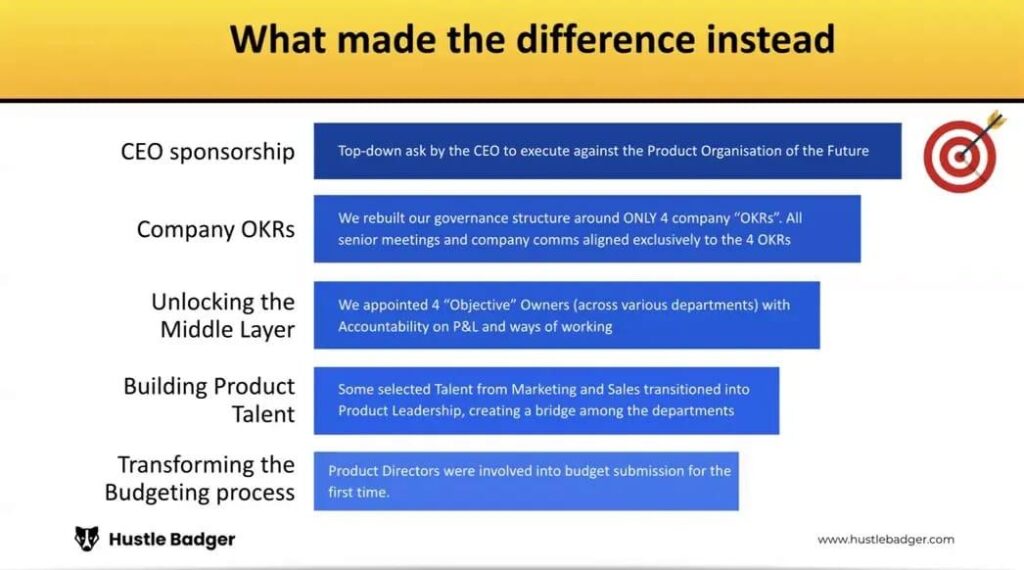
That budgeting choice signalled a shift: product teams were now expected to help cover the company’s upside, not just deliver engineered features.
It required the CEO to take political risk with shareholders, and it made product ownership real.
“Change must be driven from the top.” — Carlotta Negri di Sanfront
Set measurable objectives and cascade them
Replace aggregate, high‑level goals (eg “increase revenue”) with a small set of company objectives that cascade into product outcomes.
At giffgaff they boiled company goals down to four clear OKRs and mapped product objectives to those OKRs.
Benefits of this approach:
- One team: everyone — product, marketing, finance, engineering — works to the same short list of priorities.
- Links activity to financial metrics: It becomes possible to translate P&L targets into specific product metrics and experiments.
- Clear accountability: It reduces the “everyone owns everything” problem that makes it hard to learn from failure.
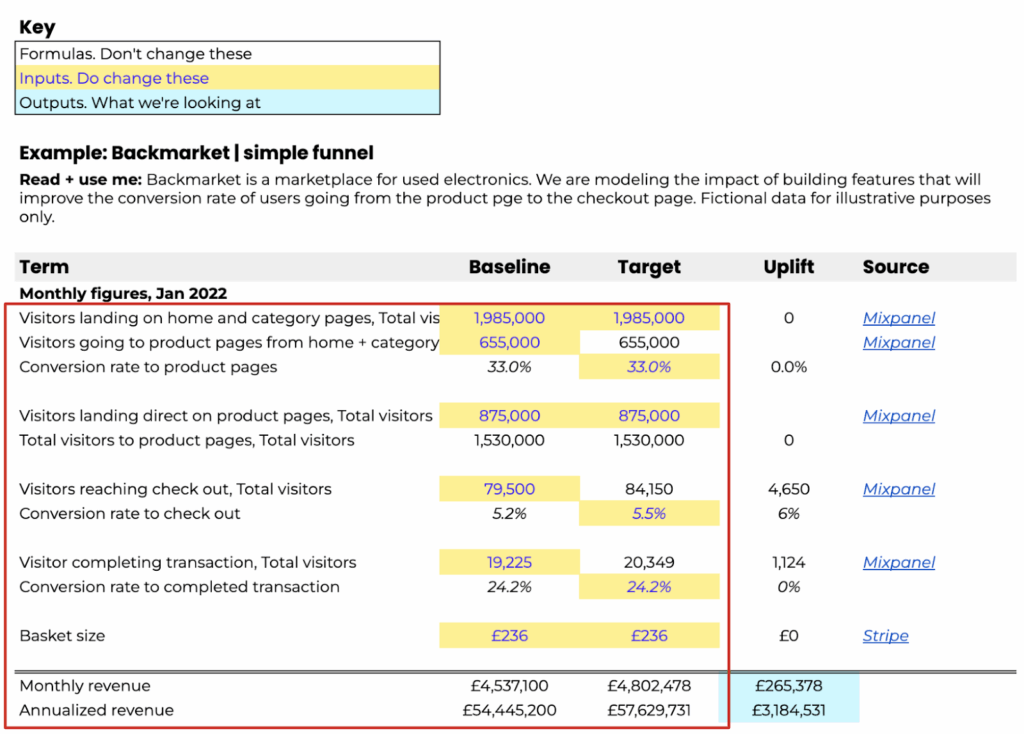
Hustle Badger Impact Modelling Guide
Create true cross‑functional teams — and test them
Cross-functional teams are key to breaking down silos and improving your product operating model. These cross‑functional teams must include product, engineering, UX, data and product marketing where possible. The aim is to create end‑to‑end ownership for customer outcomes rather than task allocation across departments.
Example:
The giffgaff leadership team built a “superstar” cross‑functional team and deliberately put it on the riskiest, highest‑impact product: mobile contracts.
The idea was to force accountability — if this team failed, the company revenue plan would suffer.
The trial produced two vital lessons:
- Execution matters: assembling top talent is necessary but not sufficient. Relationships between the new team and the existing organisation need explicit design.
- Support is critical: product managers were ready to own P&Ls, but they needed sustained support, coaching and clearer data workflows to succeed under pressure.
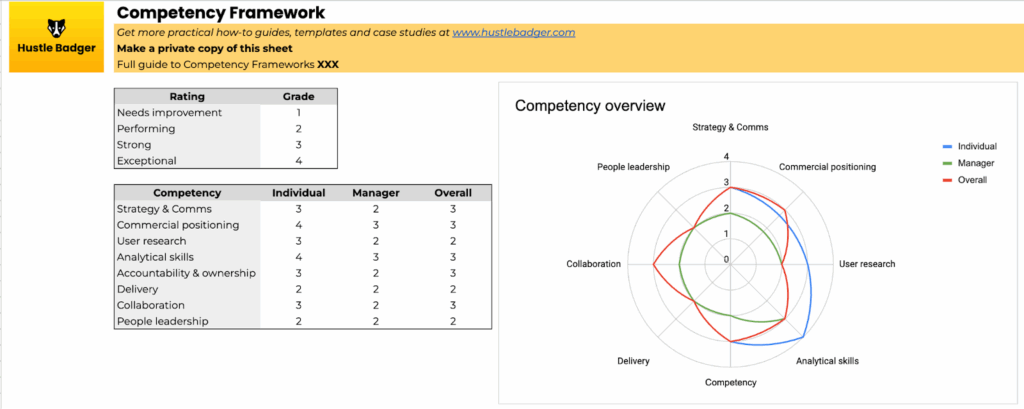
The Hustle Badger Competency Framework Template
Treat trials as experiments
Trials are just that – trials. Some will work, some will fail, but valuable learnings can be gathered in every instance.
Example:
The mobile contracts trial shared above, staffed with our superstar team, didn’t hit all its targets.
That was useful.
The objective wasn’t to show instant success: it was to surface organizational gaps in talent, data, governance and integration.
The “superstar team” was necessary to test the operating model under pressure — but it exposed how fragile change is if it’s carried by only two leaders. Carrying a vision requires broad ownership.
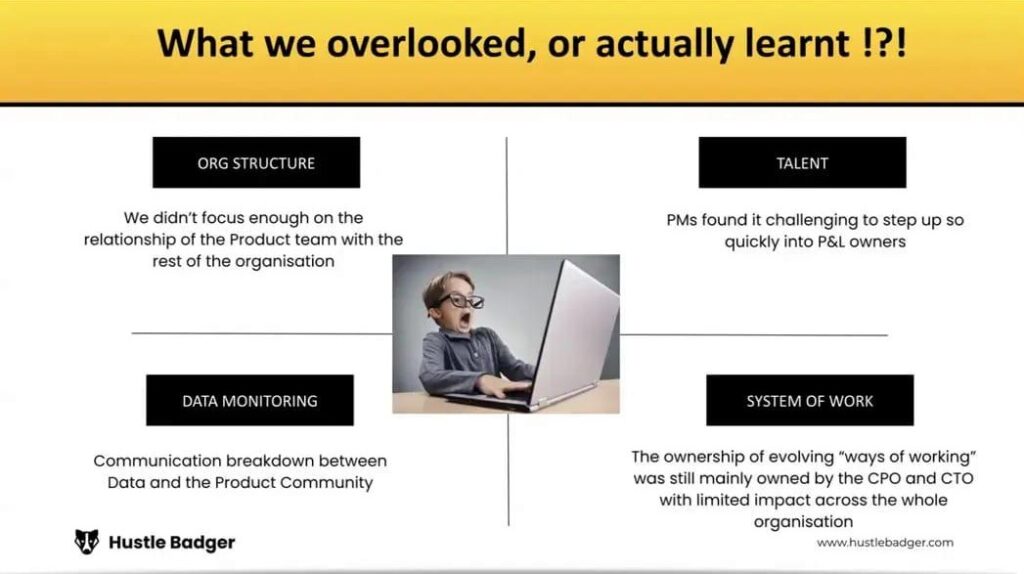
Concrete actions taken after the trial:
- Diagnose what went wrong: was it team composition, incentives, data access, technical legacy or stakeholder buy‑in?
- Accept responsibility at leadership level: rework the operating model elements that created friction.
- Document learnings: iterate the team design rather than disbanding the experiment.
“Be open to the fact that [an experiment] might disprove your assumption.”
Invest in processes, data and talent
After our failed trial the giffgiff leadership rethought the preconditions for success.
They focused on four operational levers:
- Data governance and analytics flows: embed analysts with product teams and ensure data is analysed to be product‑ready (not just reported to executives).
- Technical tooling and legacy systems: invest to remove bottlenecks that slow experiments and releases.
- Talent density: recruit or reallocate people with product, UX and commercial skills into teams that must deliver outcomes.
- Governance and rituals: redesign meeting cadence, board reporting and decision rights to support product ownership rather than siloed approvals.
At giffgaff these changes were coupled with a cultural shift: the CPO and CTO presented a joint vision and held themselves accountable for swapping budgets and hiring roles where needed.
The alliance between CPO and CTO was essential to unstick resource arguments and to present a unified leadership message.
However embedding a data analyst is not a silver bullet. Data needs governance, analysis skills and product teams who know how to ask the right questions.
Changing job titles and shifting vacancies can reallocate talent without increasing headcount, but expect to revalidate the resourcing model each year rather than assume it’s solved for good.
Protect exploration while optimising the core
A common corporate dilemma: fund the cash cow while growing new revenue streams.
At giffgaff this tension was acute because mobile dominated the P&L. The practical approach that Carlotta Negri di Sanfront used included:
- A common pool mentality: treat product and engineering resource allocation as a shared problem; the CPO and CTO traded budget lines to resource priority bets.
- Resourcing discipline: resist ad‑hoc requests to pull engineers to the core; illustrate the true cost of moving people (context switching, domain knowledge loss, team momentum).
- History as evidence: remind stakeholders of prior projects that looked promising but failed; use learning to temper optimism bias.
Stand your ground when necessary, but be logical and collaborative. Carlotta Negri di Sanfront described holding the line as uncomfortable but essential — exploration needs stable teams, not serial reallocation.
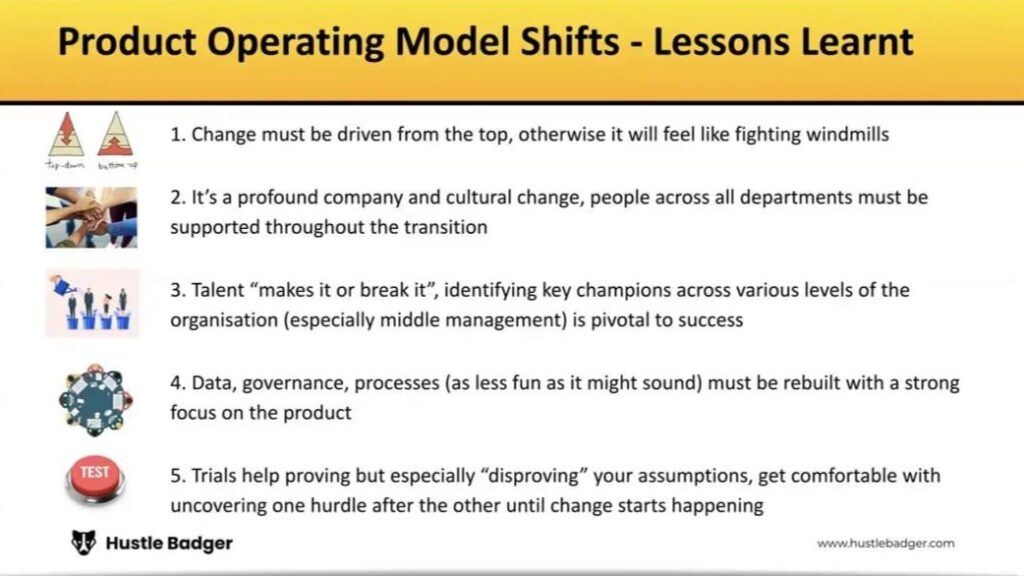
“We wanted to build products that were really answering users’ needs.”
How to get started today
- Workshop: Host a leadership workshop to agree the top 3–4 company objectives and map each to product metrics.
- Pick your target: Identify one product that is both high‑impact and feasible for a trial team; document success criteria before starting.
- Resource: Embed a data analyst with the chosen product team, and set a weekly “data readiness” ritual for metrics review.
- Align: Create a small coalition of influencers outside product (eg heads of marketing, finance) and give them a mandate to evangelise the new model.
- Commit: Rework next year’s budget to include at least one stretch target that product teams must help deliver, with CEO visibility.
How to measure progress
It’s key to measure the change. Recommended metrics:
- Product accountability: Percentage of company objectives that have ownerable product KPIs.
- Perspectives: Number of cross‑functional teams with embedded data and product marketing.
- Experiment mindset: Time to decision for product experiments and mean time between deploys.
- Commitment: Ratio of budget protected for experimentation vs budget allocated to core maintenance.
- Net outcomes: new product revenue contribution as a percentage of total revenue (quarterly).
Wrap Up
The transition to a product‑centric organisation requires a sustained leadership programme.
Success is built on:
- Early experiments that reveal constraints and build organisational muscle.
- Concrete OKRs that replace vague targets and create a single source of truth for priorities.
- CEO sponsorship and visible leadership to protect political risk and to align budgets.
- Explicit investment in talent, data and governance so teams can deliver outcomes and learn quickly.
If you are leading this change, keep three principles front of mind:
- Be patient: cultural change is a years‑long commitment.
- Be rigorous: measure what matters and be honest about what experiments reveal.
- Be visible: make sponsorship and decision rules explicit so the organisation understands where authority and accountability sit.
For product leaders, the core job is to design not only products but the operating conditions that allow those products to win.
Hustle Badger Resources
[Live classes]
[Articles]
[On demand courses]